


Most competitor keyword analyses end as a spreadsheet with several thousand rows and no owner. Someone exports a rival’s ranking keywords, sorts by search volume, shares the file, and nothing changes on the website.
The problem is not the tools. It is that the method stops at data collection instead of carrying on until every useful keyword has a page and a decision attached to it.
The seven steps below are built for UK businesses, where search volumes are smaller than in the US and a careless approach to the data can mislead you quickly.
A Seven-Step Competitor Keyword Analysis for UK Businesses Method To Work On It
Step 1: Set the Market Before You Pull Any Data
Every keyword tool defaults to a location, and many default to the United States. For a UK business that single setting changes everything. Search behaviour, spelling and volumes differ, and a keyword that looks worth chasing in US data may barely register here.
The difference is easy to see with the topic of this article. Between September 2025 and August 2026, “competitor keyword analysis” averaged about 390 monthly searches in the UK against about 1,300 in the US.
“Competitor keywords” averaged about 110 in the UK and 590 in the US.
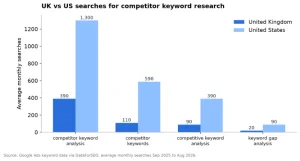 Figure 1: Average monthly searches for competitor keyword terms, UK vs US, September 2025 to August 2026 (Google Ads data via DataForSEO).
The UK figures are a fraction of the US ones, and the gap is not consistent from term to term. “Keyword gap analysis” sits at about 20 a month in the UK and about 90 in the US.
If your tool is set to the wrong country, both your priorities and your expectations will be off. Set the database to the United Kingdom, set the language to English, and note it at the top of your working file.
Step 2: Separate Search Competitors From Business Competitors
The companies your sales team worries about are not always the sites that outrank you. A regional accountancy firm may lose business to the practice down the road, yet lose search visibility to national publishers, software vendors and government guidance pages.
Build two short lists:
- Business competitors: firms that win the same clients, named by your sales or leadership team.
- Search competitors: domains that repeatedly appear on page one for your core terms, found by searching ten to twenty of your main keywords on google.co.uk and noting who shows up.
Use three to five search competitors for the analysis. Include a business competitor only if it also ranks. Publishers and directories belong on the list too, because they occupy the results you want, even if you would never pitch against them.
Step 3: Export Ranking Keywords for Each Competitor
Pull the organic keywords each competitor ranks for in the UK, along with their position and the ranking URL. Limit each export to keywords where they rank in roughly the top twenty. Beyond that, the data is mostly noise.
Do the same for your own domain so you have a like-for-like comparison.
Step 4: Clean and Merge the Variants
This is the step most analyses skip, and it is where the inflated totals come from. Keyword lists are full of near-duplicates: singular and plural forms, reordered words, UK and US spellings, and minor additions like “uk” or “near me”.
Google Ads data compounds the issue. “Competitor keyword analysis”, “competitor keyword research” and “keyword competitor analysis” show identical monthly figures because Google Ads groups close variants together.
Add all three to a forecast and you have counted the same demand three times.
Merge variants into a single row with one primary keyword and a list of the alternates. Keep the volume once. The cleaned list is usually much shorter, and much easier to act on.
Step 5: Sort the Gaps Into Three Types
With a clean list, compare your rankings to your competitors’ and give every keyword a gap type.
| Gap type | What it means | Typical action |
| Missing | Competitors rank, you have no ranking page | Create a page or section, if the intent fits your business |
| Weak | You rank, but well below competitors | Improve the existing page rather than starting again |
| Shared | You and competitors both rank well | Protect and refresh; low priority for new work |
Weak gaps are often the quickest wins, because the page already exists and search engines already associate it with the topic.
Step 6: Check Intent on the Live Results Page
Volume and difficulty scores tell you nothing about what the searcher wants. Before any keyword goes into the plan, search it on google.co.uk and look at what actually ranks.
Are the results guides, product pages, comparison articles, local listings or tools? If the top results are all free calculators and you sell consultancy, the keyword is unlikely to bring you clients, however good the volume looks.
While you are on the results page, look at the AI Overview where one appears. Note which sites are cited as sources and what kind of content they are.
Google explains in its guidance on AI features and your website that these features draw on its search index, so pages that are indexed, clear and specific are the candidates.
A competitor that is cited repeatedly in AI Overviews for your topics is a search competitor even if it does not top the traditional results.
If you want to see how these checks look when applied to a real keyword set, this worked example of a competitor keyword analysis walks through the process from exports to a finished priority list, which is handy to keep open while you build your own.
Step 7: Prioritise, Then Assign Every Keyword to One Page
Score each remaining keyword on three things: business value (would a visitor searching this become a customer?), gap type, and the effort needed to compete based on what you saw in step 6. A simple one-to-three scale on each is enough.
Then assign each keyword, or merged keyword group, to exactly one URL. That URL may be an existing page or a planned one. Two rules apply:
- One primary keyword group per page. If two pages target the same group, they will compete with each other, and neither will perform as well as one strong page would.
- Check before you create. Search your own site for the topic before commissioning a new page. Cannibalisation often starts when a new blog post is written on a subject an older service page already covers.
The output is a page map: URL, primary keyword, supporting variants, gap type, priority and owner.
Turning the Analysis Into Work
A competitor keyword analysis is only finished when it produces tasks with names and dates against them.
To get there:
- Run the analysis on UK data, and say so in the file.
- Pick search competitors from real results, not from the sales pipeline alone.
- Merge variants before you total any volumes.
- Look at the live results and AI Overview citations before committing to a keyword.
- Give every keyword group a single page and a single owner.
Repeat the process every six months. Competitors change, results pages change, and the page map should change with them.
Author Profile

- Guest Blogger & Outreach Expert - Interested in Writing Blogs, Articles in Business Niche | News Journalist By Profession in the United Kingdom
Latest entries
 BusinessOctober 7, 2026Competitor Keyword Analysis for UK Businesses: A Seven-Step That Ends in a Plan
 TechnologyJuly 16, 2026What Are the Benefits of an AI Website Builder?
 Business NewsJune 23, 2026What Are the Benefits of Following UK Business News and Journals?
 TechnologyMarch 27, 2026Why IT Asset Recovery Should Be Part of Every UK Business Strategy?